2025-26 Orchestra Repertoire Report
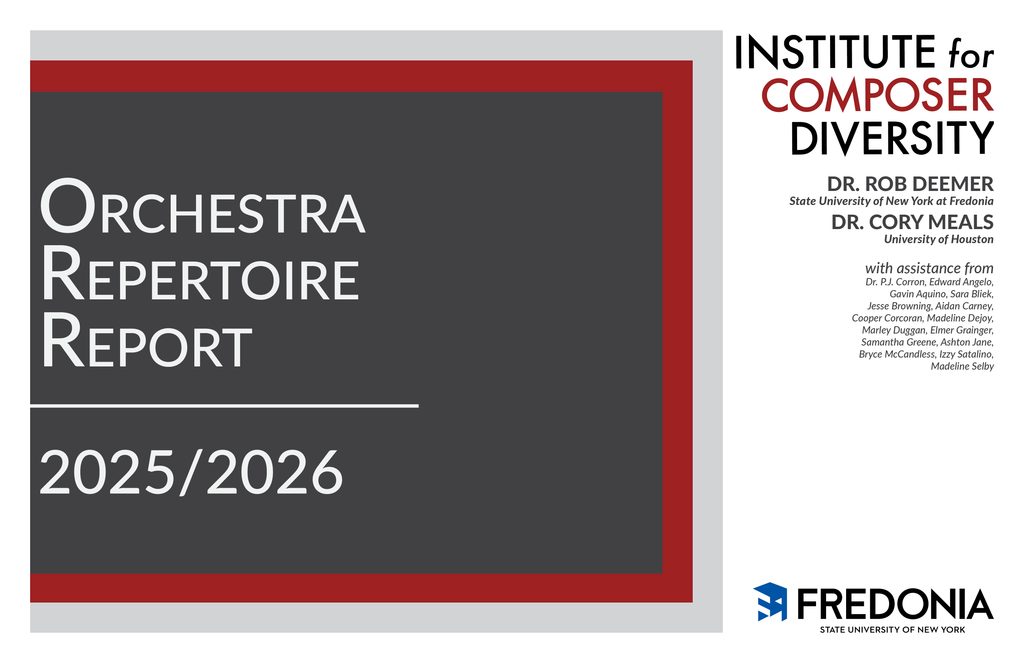
The Orchestra Repertoire Report from the Institute for Composer Diversity (ICD), produced in partnership with the League of American Orchestras, examines the programming by U.S. orchestras, focusing on composers of color, women and non-binary composers, and living composers.
The report tracks programming trends from the 2015-16 to 2025-26 seasons. It draws on repertoire data collected from 423 orchestras in all budget groups throughout the United States, including 86 youth orchestras. Composer demographics were identified from ICD’s self-reported data and from additional biographical research.
Exploring works by these composers can help orchestras broaden their repertoire and connect with audiences. ICD’s Orchestra Repertoire Search Resource provides access to more than 15,000 works programmed by U.S. orchestras from the 2021-22 through the 2023-24 seasons. Users can search by composer, title, duration, performing orchestra, and whether a work features soloists.
League Insights
Percentages refer to the proportion of programmed works. Figures are rounded to the nearest 0.5 percentage point.
Demographic Trends
3-season overview: Between 2022–23 and 2025-26, the representation of male composers of color declined, while that of white men increased.
The proportion of programmed works by white women and nonbinary composers remained broadly stable, while the proportion of women and nonbinary composers of color declined.
| Works by | 2022–23 | 2023–24 | 2024–25 | 2025–26 |
| Men of color | 12% | 10.5% | 10% | 8.5% |
| Women/nonbinary composers of color | 6% | 6% | 5% | 4.5% |
| White women/nonbinary composers | 6% | 6% | 5.5% | 6% |
| White men | 75% | 76% | 78.5% | 79.5% |
3-season racial and ethnic detail: During these three seasons, the percentage of works by Black composers showed the largest percentage-point decline among the racial and ethnic groups studied.
| Works by | 2022–23 | 2023–24 | 2024–25 | 2025–26 |
| Black composers | 10% | 9% | 7.5% | 6.5% |
10-season context: Together, the proportion of works by all composers of color and women and nonbinary composers increased substantially between the 2015-16 and 2022-23 seasons, then declined somewhat between 2022-23 and 2025-26.
Over the same period, the proportion of works by white men declined, then increased.
| Works by | 2015–16 | 2022–23 | 2025–26 |
| Composers of color and women/nonbinary composers | 4.5% | 24% | 19% |
| White men | 95% | 75% | 79.5% |
3-season detail by budget group: Works by composers of color and by women and nonbinary composers consistently accounted for a higher proportion of programming among medium-budget orchestras than among larger-budget orchestras.
| Orchestra category | 2022–23 | 2023–24 | 2024–25 | 2025–26 |
| Larger-budget orchestras | 20.5% | 20%–21% | 18.5%–20% | 17%–19.5% |
| Medium-budget orchestras | 27%–29% | 21%–26.5% | 22%–24% | 20.5%–22.5% |
| Youth orchestras | — | — | — | 19.5% |
Youth orchestra figures are shown for 2025-26 only: changes in the sample prevent reliable trend analysis.
Living Composer Trends
10-season overview: The proportion of programmed works by living composers nearly doubled over the decade, and has remained broadly stable in recent seasons.
| Works by | 2015–16 | 2022–23 | 2023–24 | 2024–25 | 2025–26 |
| Living composers | 11.5% | 22.5% | 22% | 21% | 22.5% |
| Deceased composers | 88% | 77% | 76% | 77.5% | 76% |
3-season detail: Between 2022-23 and 2025-26, the representation of all living composers of color declined, while the representation of living, white, male composers increased.
| Works by living composers | 2022–23 | 2023–24 | 2024–25 | 2025–26 |
| White men | 6.5% | 8.5% | 7.5% | 9.5% |
| Men of color | 7% | 6.5% | 5.5% | 5% |
| White women/nonbinary composers | 4.5% | 3.5% | 4% | 4.5% |
| Women/nonbinary composers of color | 4% | 4% | 4% | 3.5% |
Methodology
The Institute for Composer Diversity analyzed U.S. orchestras’ published season announcements and concert programs, supplemented by programs collected from League member orchestras. Data for 2015-16 and 2017-18 came from the Baltimore Symphony Orchestra’s earlier research. The analysis focused on mainstage classical or masterworks programming, excluding pops, film, children’s and chamber concerts and tours. Composers were classified using the Institute’s database of self-reported composer demographics, and through additional biographical research.
Coverage grew from 85 orchestras in 2015-16 to 423 in 2025-26. From 2022-23, it expanded beyond the five largest budget groups to include all eight budget groups and youth orchestras; the latest season includes 86 youth orchestra programs.
Not every orchestra had data for every season. To check whether changing coverage affected the findings, the researchers grouped orchestras by the number of seasons represented and compared demographic patterns within each season. They found no significant differences among orchestras in budget groups 1-8.
Youth orchestras, in contrast, saw participation rise from 12 to 86 ensembles between 2022-23 and 2025-6. Because this changing sample prevents reliable comparisons between seasons, we present youth orchestra results as individual-season snapshots rather than a separate trend analysis. Their inclusion did not significantly affect the overall findings.
Questions about these League Insights?
Please contact knowledge@americanorchestras.org.


The League’s partnership with the Institute for Composer Diversity on the 2025-26 Orchestra Repertoire Report is supported by a grant from The Aaron Copland Fund for Music and by public funds from the New York City Department of Cultural Affairs in partnership with the City Council and the New York State Council on the Arts with the support of the Office of the Governor and the New York State Legislature.
Related
-
News | Advocacy
Take Policy Action this Summer
-
Learn | Artistic Planning
Music Director Search Handbook
-
Learn | Audience Engagement
Leadership Strategies During Periods of Unpredictability
Become a member
Thank you for your interest in the League of American Orchestras! We are dedicated to advancing the orchestral experience for all.
Join Now